


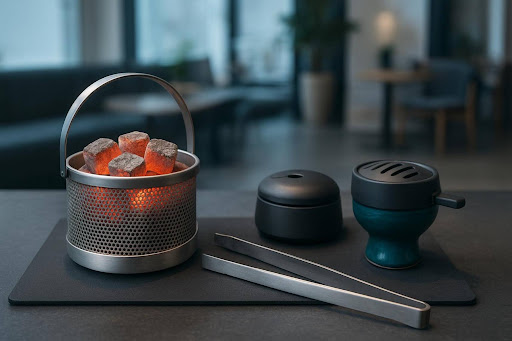
Charcoal controls heat in a hookah by acting as an indirect heat source. It sends thermal energy through radiation, conduction, and convection into the shisha below. The charcoal does not burn the shisha directly. Instead, it transfers heat through a metal barrier, such as aluminum foil or a heat management device. This creates a strong temperature difference between the charcoal and the tobacco.
The heat must gently vaporize glycerol, molasses, and flavorings at about 150°C to 220°C without passing the 230°C point where tobacco leaves begin to burn. The position, material, airflow exposure, and size of the coals affect how evenly heat moves across the bowl and down through its layers.
Burning carbon cannot hold one fixed temperature throughout a session, so the heat level changes over time. Before starting, choosing reliable accessories and quality charcoal hookah supplies creates a stable base for managing these changes. Each draw through the pipe changes the oxygen supply. This can briefly increase coal combustion while pulling very hot air through the shisha. Learning how charcoal behaves helps produce thick, flavorful clouds without burning delicate flavor compounds.
What Is the Role of Charcoal in Hookah Heat Distribution?
Charcoal is the main heat source for the entire waterpipe. Unlike cigarettes or cigars, where tobacco burns through direct contact with a flame, a hookah uses mostly indirect heat. The charcoal sits above the bowl and sends strong heat downward while staying separate from the moist shisha. This gap makes the charcoal send energy across a boundary, creating a controlled warm area inside the bowl. The mixture heats from the top down.
Charcoal has two main jobs. It heats the solid parts of the setup, such as the foil or metal device, and it also heats the air that enters the bowl during a draw. The way this energy spreads decides whether the whole tobacco pack is used or whether only the top layer cooks while the lower part stays wet and unused.
Why Heat Distribution Affects Flavor, Smoke, and Session Length
Hookah tobacco is mainly made from cured tobacco leaves soaked in vegetable glycerin, molasses or honey, and flavor oils or essences. Pure glycerin boils and turns to vapor at about 290°C. Inside the moist shisha mixture, however, the best vaporization range is usually about 180°C to 220°C. When heat spreads evenly, these ingredients become an aerosol slowly. This creates thick, smooth clouds with clear flavors that can last for 90 minutes or more.
Uneven heat creates hot spots. When these areas rise above 230°C, the molasses can burn and the sugars can caramelize too far. This produces harsh aldehydes and damages the flavor. If heat does not reach the outer edges or lower parts of the pack, much of the flavor stays unused. The result is a shorter session with thin smoke and weak taste.
The Difference Between Heat and Direct Combustion
Many beginners think hookah smoke comes from burning tobacco. In fact, traditional hookah smoking mainly heats and boils liquids away from an organic material. Charcoal supplies the heat needed for this change without creating an open flame inside the bowl.
Direct combustion happens when plant material catches fire in the presence of oxygen. This destroys flavor molecules and creates ash, harsh particles, and carbon soot. Hookah charcoal is meant to provide steady heat without dropping embers or sparks into the shisha. This allows the user to inhale an aerosol made mainly from vaporized humectants instead of burned cellulose.
What Are Hookah Charcoals Made Of?
Most modern hookah charcoals are made from compressed coconut shell carbon. Traditional wood coals and chemical quick-lighting briquettes are also available. Coconut charcoal is popular because coconut shells and husks create a dense, clean carbon source with very few volatile organic compounds. During production, the shells are carbonized, ground into a fine powder, mixed with a natural food-grade starch binder such as tapioca, and pressed under high hydraulic pressure into cubes, flats, or discs.
Quick-lighting coals are usually made from less dense wood charcoal or mixed carbon powders. They contain chemical oxidizers such as potassium nitrate or sulfur. These chemicals let the coal spark and light when touched with a regular lighter. This convenience has several drawbacks. The chemicals burn quickly, create strong odors during lighting, leave weak ash, and may add chemical flavors to the shisha.
Good-quality natural coconut charcoal has almost no sulfur, very little moisture, and a low ash level, usually below 2.5% to 3%. Its dense carbon structure gives it a long, steady burn with little smell. Hardwood coals are natural, but their grain and moisture can vary. This makes their heat harder to control from one session to another.
How Hot Does Hookah Charcoal Burn?
The working temperature of hookah charcoal depends on air exposure, the surrounding draft, and the type of fuel. A glowing coal gives off a large amount of heat, so that energy must be reduced before it reaches the shisha.
These temperature differences show why heat buffers, good packing, tight foil, and management accessories help protect the tobacco from burning too quickly.
Typical Hookah Charcoal Temperatures
When resting without much airflow, fully lit natural coconut charcoal cubes usually reach surface temperatures between 400°C and 530°C. The glowing core inside the cube can become much hotter, often reaching 650°C to 750°C depending on the amount of available oxygen. This is much higher than the usual 300°C to 400°C found in common backyard barbecue charcoal, which has a lower density for grilling.
Quick-lighting coals have a different heat pattern. When they ignite, their chemical accelerators can create an early spike above 440°C almost at once. Because these coals contain less carbon overall, they burn down much faster. During a longer session, their average working temperature is usually about 40°C to 50°C lower than that of coconut cubes.
How Coal Temperature Differs from Bowl Temperature
Charcoal can burn above 500°C, but the shisha should never receive that level of heat directly. A steep temperature drop forms inside the upper part of the hookah. The underside of the foil or the bottom plate of a heat management device directly below a coal may reach 350°C to 450°C.
Only two to three millimeters below that barrier, the upper shisha layer may be around 200°C to 260°C. At the bottom of a deep clay bowl, the temperature may be only 130°C to 160°C. Air gaps between the leaves, the moisture in the molasses, and the metal barrier all help reduce the extreme heat of the coal to a gentler roasting range.
Why Natural Coals Usually Provide More Stable Heat
The dense structure of coconut charcoal helps it hold heat more steadily. Since it is tightly pressed without artificial lighting chemicals, it burns evenly from the outside toward the center. It is less likely to flare up suddenly or form empty burning pockets.
Natural coals also keep a higher average working temperature during their life and create much less incomplete-combustion material, such as carbon monoxide, than quick-lighting coals. Their solid structure lets them keep transferring heat without breaking into hot ash too early.
How Charcoal Transfers Heat Across the Hookah Bowl?
Heat moves from burning charcoal into the shisha through three physical methods: radiation, conduction, and convection. Each method affects a different part of the bowl and changes depending on whether the hookah is resting or someone is taking a draw.
The balance between these three methods separates a well-prepared hookah from a poor one. Relying too heavily on one method can cause burnt spots or leave parts of the shisha without enough heat.
Radiant Heat from the Coal Surface
Radiant heat is infrared energy released from the glowing surface of the charcoal. Under the Stefan-Boltzmann law, the amount of radiant energy rises quickly as temperature increases. Since coals glow at several hundred degrees Celsius, they send strong radiant heat across the gap above the bowl.
This energy hits the top metal surface and passes through the holes in the foil or heat management device (such as the ones you can find at Shisha Boutique) to the top tobacco leaves. Radiant heat travels in a direct path. Areas directly below a coal absorb most of it, so this line-of-sight exposure is a major cause of hot spots.
Conductive Heat Through Foil or an HMD
Conduction is heat moving through direct contact. The charcoal sits on the aluminum foil or on the base of a metal heat management device. Heat moves quickly from the glowing coal into the metal surface.
The metal spreads heat across its surface before sending it into the bowl rim and the shisha leaves touching the barrier. Thick heat management devices use metal with high heat conductivity to spread heat across a wider base. This reduces the sharp temperature peaks created by the corners of individual coals.
Convective Heat from Airflow
Convection begins as soon as someone inhales through the hose. The draw lowers the air pressure inside the bowl and pulls room air down over and around the red-hot coals.
As this air passes the charcoal, it heats quickly to above 200°C. The hot air moves through the holes and travels down through the open spaces between the shisha leaves. Convection heats the inside and lower layers of the pack, which radiant and conductive heat may not reach directly.
How Charcoal Heat Changes During a Hookah Session
A hookah session does not stay at one fixed temperature. Charcoal follows a gradual cooling pattern. Its heat delivery changes from the time it leaves the burner until it becomes gray ash.
Knowing the stages of this pattern helps smokers make changes before the smoke becomes harsh or weak.
Initial Heat Spike: 0-10 Minutes
When fully lit coals are placed on a cold or room-temperature bowl, the setup experiences an early rise in heat. Fresh coals are at their hottest and have no ash layer to block their energy. Heat quickly enters the metal barrier and the ceramic bowl, warming the upper shisha.
During this first period, experienced smokers often let the bowl sit for three to five minutes without taking a draw. This gives the bowl time to absorb heat and form a steady temperature pattern. It also protects cold shisha from a sudden rush of hot air caused by heavy early draws.
Stable Heating Phase: 10-40 Minutes
From about 10 to 40 minutes, the setup usually reaches its best working balance. The clay or ceramic bowl has warmed through, the shisha has reached its useful vaporization range of 180°C to 220°C, and the charcoal is burning steadily.
Smoke output and flavor are often strongest during this period. Heat spreads more evenly across the width and depth of the bowl. Little adjustment is needed apart from an occasional purge to remove built-up moisture from the base.
Cooling and Decline Phase: 40-90 Minutes
After about 40 minutes, the charcoal becomes smaller. A layer of mineral ash builds up on each cube and acts like insulation, reducing the amount of radiant heat that escapes.
Without changes, the bowl temperature can fall below 150°C, the point where vaporization becomes weak. Smoke becomes thin and flavor fades. To keep the session going, tap away the ash, move the coals closer to the center, or add fresh coals that have already been heated.
How Foil and Heat Management Devices Control Heat Distribution
Charcoal is much too hot to touch tobacco directly, so a middle layer is needed to filter, soften, and spread the heat. The two main options are perforated aluminum foil and enclosed heat management devices. Each one handles heat in a different way.
The choice between foil and a dedicated device changes the way radiant, conductive, and convective heat reach the shisha.
How Foil Thickness and Hole Patterns Affect Heat
Aluminum foil is the traditional barrier. Standard kitchen foil is thin, usually about 10 to 14 microns, and can sag under the weight of heavy coals. When it sags, the charcoal moves closer to the shisha and sends extreme conductive heat into the tobacco. Doubling regular foil or using heavy-duty hookah foil at about 35 to 40 microns creates a firmer, tighter surface. This keeps a useful air gap between the charcoal and shisha.
The hole pattern in the foil controls the path of moving air. Many small holes create a spread-out, mild draft that sends air through the pack more evenly. Fewer large holes focus the airflow into narrow, fast streams. These streams can create burnt channels directly below the coals.
How Heat Management Devices Spread Heat
Heat Management Devices, or HMDs, are often cast-aluminum holders with vents and a lid. They replace foil and change the way heat moves. An HMD has a large amount of metal mass. When coals sit inside it, the thick aluminum floor and walls absorb much of their radiant and conductive energy.
Rather than sending heat from a few small points into the tobacco, the HMD spreads the energy across a wider area. This changes sharp heat peaks into a more even mix of conductive and radiant heat. Ridges inside the device help stop the coal bottoms from turning black because of low oxygen. Vents in the lid control airflow and can extend coal life by about 25% to 30%.
How Coal Placement Changes Hookah Heat
The location of the coals on the bowl strongly affects the temperature map inside. Heat spreads outward and downward in cone-shaped paths, so moving a coal only a few millimeters can change the temperature of the shisha below it by several dozen degrees.
Careful placement lets smokers control how quickly the bowl warms and protect delicate flavors from too much heat.
Center Placement for Faster, More Direct Heating
Putting charcoal in the center of the bowl focuses the available heat on one main spot. The middle shisha heats quickly and smoke may appear sooner. However, this placement is usually a poor choice for a long session.
Airflow is often strongest in the center of a hookah bowl. High radiant heat in this area can quickly burn the top tobacco layer. In a phunnel bowl, coals placed over the central spire also send heat down toward the stem while increasing the chance that hot ash will fall into the water.
Edge Placement for Gentler and More Even Heating
A safer and more effective starting method is to place the coals around the outer edge of the bowl. Two coals can sit opposite each other, or three can form a triangle around the rim.
Clay and ceramic bowls absorb this heat and carry it across the material, gently warming the shisha from the outside toward the center. As the coals become smaller over 15 to 20 minutes, tap away the ash and move them slightly inward. This replaces lost heat without giving the tobacco a sudden temperature jump.
How Airflow Influences Charcoal Heat Distribution
Airflow helps charcoal burn. In a hookah that is sitting unused, the coals smolder with only the small amount of oxygen carried by warm air. Taking a draw changes this balance immediately and creates fast temperature changes.
Thermocouple tests show that a charcoal-heated bowl experiences heat pulses with every inhale. This means the way a person draws directly affects the bowl temperature.
Why More Oxygen Increases Coal Combustion
Charcoal sitting in still air receives a limited amount of oxygen. When someone draws, air moves faster across the coal surfaces. This fresh oxygen speeds up carbon oxidation, making the coals glow brighter and raising their surface temperature by 50°C or more within seconds.
Heat production is dynamic because of this oxygen increase. A harder or longer draw makes the coal surface hotter. If the holes in the foil or device do not spread air evenly, coals above high-airflow areas will burn hotter and faster than coals above areas with little airflow.
How Puffing Frequency Raises Bowl Temperature
Thermocouple readings show that each puff pulls very hot air into the shisha. It also briefly pulls cooler room air across the outside of the metal, causing a temporary drop of about 50°C followed by a quick rise. When puffs are spaced about 20 to 30 seconds apart, the setup has time to release extra heat and return to its normal vaporization range.
Rapid, repeated puffing keeps sending oxygen to the coals and hot air through the shisha. This removes the cooling period and can push the tobacco above 230°C into active pyrolysis. The molasses then burns, and the quality of the session drops.
How to Prevent Overheating and Underheating
Keeping a steady temperature during a session requires attention and quick physical adjustments. Spotting a temperature change early can stop permanent damage to the shisha.
Too much heat and too little heat both reduce the quality of the session, but each problem needs a different response.
Signs of Excessive Heat and Burnt Shisha
The first sign of too much heat is often an unusual tickle or harsh feeling in the back of the throat. This can happen before the cloud changes. Above 230°C, sweet and fruit flavors begin to disappear and are replaced by a bitter, burnt taste similar to scorched sugar or dry paper.
The smoke may also become very thick, gray, and strong-smelling. If the problem continues for more than a minute, the upper shisha layer can turn black and form a hard crust. This can make the burnt taste remain for the rest of the session.
Practical Heat Control Adjustments
Take action as soon as signs of overheating appear:
- Remove one coal and place it safely on the coal tray.
- Move the remaining coals outward toward the far edge of the bowl.
- Purge the hookah firmly through the purge valve to remove trapped hot vapor and cool the lower part of the bowl.
- If you are using an HMD, remove the lid so extra heat can escape.
If the smoke becomes thin, weak, and nearly flavorless, the bowl may be too cool. Tap the ash from each coal against the tray to expose fresh glowing carbon. Turn the coals onto parts of the foil that have not been heated, move them a little closer to the center, or add a preheated cube to raise the base temperature.
What Are the Safety Risks of Hookah Charcoal?
Charcoal provides the heat needed to vaporize shisha, but burning carbon also creates serious health and physical dangers. Safe handling and proper ventilation are needed during every session.
Knowing these risks helps protect both your health and your home.
Carbon Monoxide from Burning Charcoal
Incomplete combustion of carbon-based material creates carbon monoxide, or CO. This gas has no color, smell, or taste and is poisonous. In a hookah, charcoal is by far the main source of carbon monoxide, producing much more CO than the tobacco. Quick-lighting coals can produce more than twice the average CO of natural coconut coals because of their chemical binders and less efficient burning.
Breathing in a high level of carbon monoxide reduces the blood’s ability to carry oxygen because the gas binds tightly to hemoglobin. Early signs of mild CO poisoning can include lightheadedness, a throbbing headache at the front of the head, nausea, and confusion. In a closed or poorly ventilated room, CO can build up to dangerous levels during several sessions.
Burns, Ventilation, and Safe Coal Handling
Since charcoal can burn between 500°C and 750°C, a dropped coal can cause serious burns or start a fire. A glowing cube can scorch or ignite carpet, wood flooring, or upholstered furniture within seconds. Always carry lit coals with strong metal tongs and place them in a deep stainless-steel coal basket. Do not carry loose cubes across a room on a small tray.
Good ventilation is required for indoor sessions. Keep a window open for cross-ventilation or use an exhaust fan to bring fresh air into the room and remove smoke and gases. A fireproof silicone mat or heat-resistant fiberglass mat beneath the hookah can protect the floor if the base tips or hot material falls.
Used coals also need careful handling. A coal that looks cold on the outside may still contain a glowing center beneath its ash. Never put used coals into a dry trash can or plastic container. Fully submerge them in water, or place them in a sealed, heavy metal ash bucket until all carbon is out and the coals are cold to the touch.
